Total Call Automation with AI: Revolutionize Your Contact Center
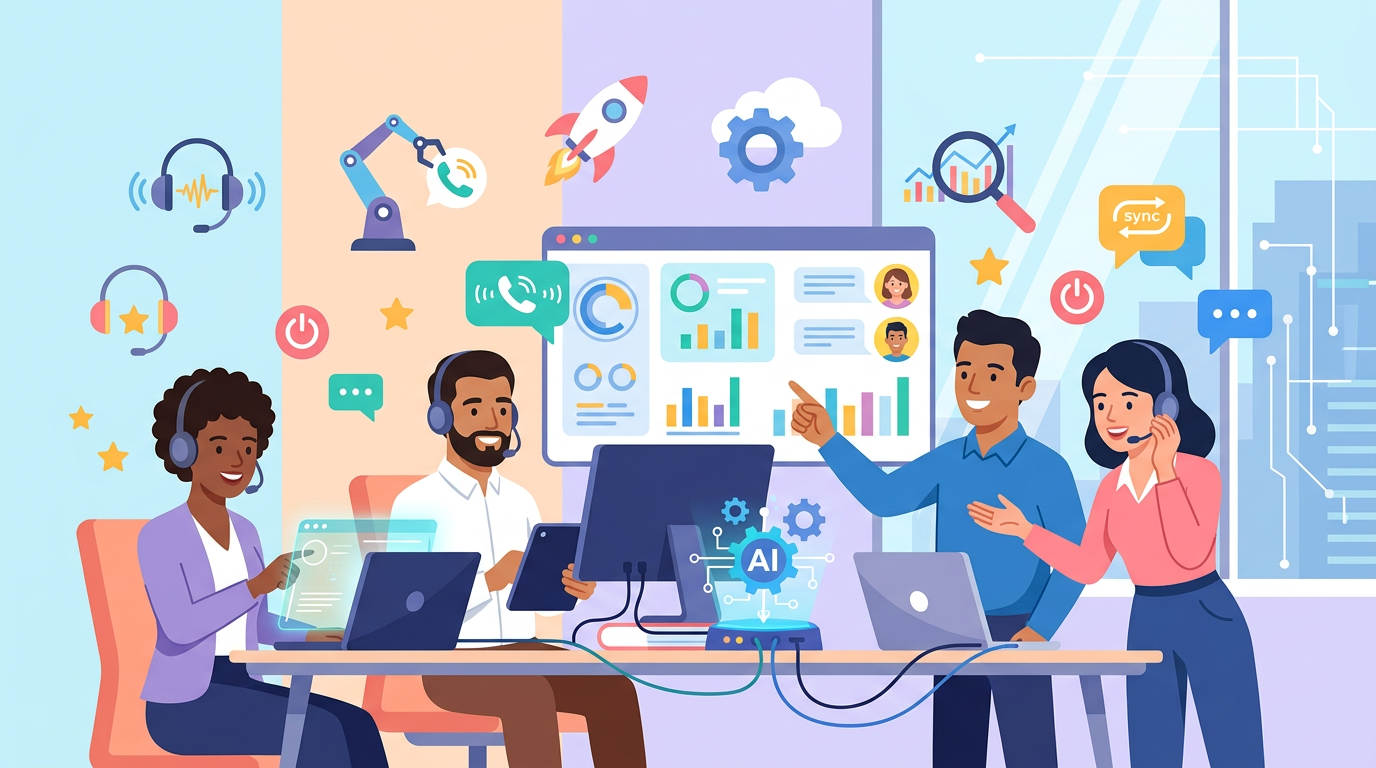
Total Call Automation with AI: Revolutionize Your Contact Center
Total call process automation with AI represents a paradigm shift in customer interaction management. In the digital age, where immediacy and personalization are key, companies are looking for solutions that allow them to optimize their operations and offer exceptional experiences. Artificial intelligence (AI) is the engine of this transformation, enabling systems capable of managing the complete voice process, from initial reception to the resolution of complex queries, freeing up human resources and improving user satisfaction.
Traditionally, contact centers have relied heavily on human agents for all interactions. While human interaction remains valuable, growing demand, the need for 24/7 service, and the pursuit of efficiency have driven the adoption of AI technologies. A frontline bot not only filters and redirects calls but can also resolve frequently asked questions, perform transactions, and personalize service, all guided by an automated customer journey designed to maximize efficiency.
What Does Total Call Process Automation with AI Involve?
Total automation goes beyond a simple IVR (Interactive Voice Response). It involves a sophisticated orchestration of AI technologies such as natural language processing (NLP), natural language understanding (NLU), natural language generation (NLG), and machine learning (ML) to create an autonomous and adaptable customer service system. This approach allows a significant portion, or even all, of telephone interactions to be managed by virtual agents. This model radically transforms operational efficiency, as shown by success stories where a 30% reduction in waiting times and a 25% increase in first-call resolution have been achieved.
| Key Components of Total Automation | Description |
|---|---|
| Virtual Assistants and Voice Chatbots | AI-powered conversational agents capable of understanding, processing, and responding to customer inquiries naturally. |
| Natural Language Processing (NLP) | Allows AI systems to understand the meaning and intent behind spoken or written human language. |
| Natural Language Generation (NLG) | Enables bots to generate coherent and contextual responses in natural language, mimicking human conversation. |
| Machine Learning (ML) | Enables systems to learn from past interactions, continuously improve their performance, and adapt their responses to new situations. |
| Integration with Business Systems | Connection with CRMs, ERPs, and other databases to access customer information and offer personalized and contextual responses. |
Benefits of Total Call Process Automation with AI
The implementation of total call process automation with AI offers a multitude of strategic and operational benefits for any company, regardless of its size or sector. These benefits translate into tangible improvements in customer experience, operational efficiency, and ultimately, business profitability.
1. 24/7 Availability and Immediate Attention
An AI-powered voice assistant doesn't sleep. It's available 24 hours a day, 7 days a week, 365 days a year. This means your customers can get answers and solutions at any time, reducing frustration due to waiting times or inability to contact outside business hours. This level of availability is a key differentiator in a competitive market and directly translates into higher customer satisfaction.
2. Reduction in Operational Costs
Efficiency is one of the pillars of automation. By managing a high volume of calls, voice bots can significantly reduce the need for additional staff for repetitive or low-value tasks. Industry studies indicate that automation can reduce agent-handled calls by 20-40%, which translates into substantial savings in salaries, training, and office space. Furthermore, by optimizing the automated customer journey, the average handling time (AHT) is minimized, positively impacting profitability.
3. Improved Customer Experience
Personalization is key. AI systems can instantly access customer history from the CRM (like those offered by MarketiKing, for example, those described in Discover the Best CRM Solutions for Modern Businesses) and other systems to provide contextualized service. This not only makes the customer feel valued but also leads to a faster and more accurate resolution of their issues. A well-designed complete voice process ensures that the customer feels their needs are understood and addressed effectively.
4. Effortless Scalability
Call spikes, whether seasonal or unexpected, can quickly overwhelm a traditional contact center. Virtual agents, however, can simultaneously handle an unlimited number of interactions without compromising service quality or speed. This flexible scalability ensures that your business is always prepared for any volume of demand, maintaining high service levels even during peak times.
5. Consistency in Service Quality
Unlike human agents, who can be affected by fatigue or mood, AI bots offer consistent and standardized service in every interaction. This ensures that every customer receives the same quality of care, following company protocols and information uniformly. This consistency reinforces brand image and customer trust.
6. Improved Data Collection and Analysis
Every interaction managed by an AI bot generates valuable data. This data can be analyzed to identify patterns, bottlenecks, and areas for improvement in customer service, as well as to better understand customer needs and preferences. This information is crucial for strategic decision-making and continuous improvement of your business processes. Discover how good management with a CRM can enhance this in What is a CRM and How Can It Transform Your Business?.
Key Components for Successful Implementation
To carry out total call process automation with AI effectively, it is essential to consider and plan the integration of various technological components. The right combination of these tools ensures a robust, efficient, and customer-centric system.
1. Advanced AI Voice Platforms
The foundation of the entire system is a platform capable of processing natural language and generating coherent responses. These platforms should include:
- Automatic Speech Recognition (ASR): To accurately transcribe customer speech to text.
- Natural Language Understanding (NLU): To interpret the intent and meaning behind the customer's words.
- Natural Language Generation (NLG): To formulate clear and natural responses from the bot.
- Text-to-Speech (TTS): To convert the text generated by the bot into audible speech.
2. Integration with CRM and ERP
The ability of your AI system to access and update real-time information from your CRM (Customer Relationship Management) and ERP (Enterprise Resource Planning) system is critical. This integration allows for:
- Personalization: Accessing customer history, preferences, and purchase data to offer tailored service.
- Problem Resolution: Obtaining relevant information to resolve queries without needing to transfer the call to a human agent.
- Record Updates: Automatically logging interactions and resolutions in business systems, maintaining consistent information. For more details on CRMs, visit CRM for Companies: Boost Your Growth with MarketiKing Solutions or Types of CRM for Businesses and Choose the Ideal One.
3. Design of the Automated Customer Journey (ACJ) or Customer Journey Automation
Defining the automated customer journey means designing the interaction flow that the voice bot will follow. This includes:
- Intent Mapping: Identification of the most common reasons for calls and how the bot can handle them.
- Dialog Creation: Development of intelligent conversational scripts that guide the customer to the solution.
- Transfer Points: Establishing clear criteria for escalating the call to a human agent when the AI cannot resolve the situation.
- Flow Personalization: Adapting the journey based on the customer's profile, history, or reason for the call.
4. Analytics and Reporting Tools
To ensure continuous improvement and long-term success of automation, it is essential to have tools that allow for:
- Real-time Monitoring: Supervising bot performance and customer satisfaction.
- Interaction Analysis: Extracting information from conversations to identify trends, inefficiencies, or new opportunities.
- Report Generation: Creating detailed reports on key metrics such as call volume, resolution time, AI success rate, and customer satisfaction.
Use Cases and Practical Examples
Total call process automation with AI has applications in a wide range of sectors, demonstrating its versatility and effectiveness. From banking to retail, companies are leveraging the complete voice process to optimize their operations.
Financial and Banking Sector
- Balance and Transaction Inquiries: Customers can inquire about their account balance, transaction history, or check the status of their payments securely and automatically.
- Card Management: Blocking or unblocking cards, changing PINs, or requesting new cards, all via voice.
- Basic Advice: Information on financial products, currency quotes, or loan requirements.
Telecommunications
- Service Activation: Activating new lines, increasing internet speed, or contracting additional packages.
- Level 1 Technical Support: Resolving common connectivity problems (e.g., restarting router), device configuration, or checking the status of an outage.
- Billing Management: Viewing invoices, explaining charges, or managing payments.
Retail and E-commerce
- Order and Tracking: Customers can place orders, check the status of their shipment, or request returns and exchanges.
- Product Inquiries: Information on features, in-store availability, or personalized recommendations.
- Store Locator: Providing directions, opening hours, and contact details for physical stores.
Health
- Appointment Management: Scheduling, canceling, or modifying appointments with doctors or specialists.
- General Information: Checking clinic hours, preparing for exams, or frequently asked questions about services.
- Reminders: Sending automatic appointment or medication reminders.
Public Services
- Meter Reading: Registering water, electricity, or gas readings via telephone.
- Incident Information: Reporting problems such as supply outages or breakdowns and getting updates on their resolution.
- Billing Inquiries: Questions about consumption, explaining the bill, or managing service payments.
Consider how these voice automations compare to traditional solutions and new voice bot trends, as detailed in the post Traditional Call Center vs. Voice Bot: Which Will You Choose in 2024?. Additionally, monitoring these interactions and continuous optimization of bots are essential. For example, at MarketiKing, our AI solutions are designed to be adaptable and scalable, ensuring that the frontline bot not only fulfills its initial function but also evolves with the needs of the business and the customer.
Challenges and Considerations When Implementing Total Automation
Although total call process automation with AI promises countless benefits, its implementation is not without challenges. It is crucial to address these considerations proactively to ensure success and maximize return on investment. Careful planning and choosing the right technological partner are fundamental.
| Challenge | Consideration for the Solution |
|---|---|
| Natural Language Complexity | Accents, dialects, background noise, and ambiguity in phrases can make it difficult for the bot to understand. Solution: Use advanced NLP/NLU engines, train the bot with large volumes of sector-specific and regional data, and design robust dialogues that handle exceptions and intelligently request clarifications. |
| Integration with Legacy Systems | Companies with old CRM, ERP, or data management systems may face difficulties integrating new AI technology. Solution: Plan a detailed integration phase, possibly using intermediary APIs or iPaaS (Integration Platform as a Service) solutions. It is key that data is clean and accessible. |
| User Experience (UX) Design | Poor design can frustrate customers and cause them to abandon the interaction. Solution: Focus on intuitive conversational design, offer clear options, allow natural interruptions, and ensure that the complete voice process is fluid and efficient. Thorough testing with real users is essential. |
| Continuous Maintenance and Optimization | Voice bots are not a 'set it and forget it' solution. They require constant monitoring, analysis, and adjustments to improve their performance. Solution: Establish a team dedicated to monitoring metrics (resolution rates, customer satisfaction), gathering feedback, and continuously training the AI model with new interactions. |
| Data Security and Privacy | Managing sensitive customer information is a primary concern. Solution: Implement robust security protocols, data encryption, compliance with regulations like GDPR or LOPDGDD, and ensure that the solution architecture is designed with user privacy in mind from the outset. |
| Internal Resistance to Change | Employees who fear job loss or the complexity of new technology may show resistance. Solution: Design a transparent communication plan about the benefits of AI (not to replace, but to empower), offer adequate training, and focus on AI as a tool that allows human agents to dedicate themselves to higher-value-added tasks. |
A partner like MarketiKing, with expertise in CRM implementation for businesses and AI solutions, can guide you through these challenges, ensuring a smooth and successful transition. Addressing these points with a clear strategy and adequate commitment is crucial to turn challenges into opportunities for improvement and growth.
The Future of Contact Centers with AI
The path to total call process automation with AI is irreversible and constantly evolving. The future of contact centers will be defined by an increasing symbiosis between virtual agents and humans. This is not about total replacement, but about optimizing roles, where AI handles repetitive and high-volume tasks, freeing up human agents to focus on more complex, empathetic, and high-value strategic interactions. This hybrid approach is the most efficient and customer-centric.
We anticipate greater sophistication in AI's emotional understanding, with bots capable of detecting customer mood and adapting their tone and responses accordingly. Personalization will reach even deeper levels, with AI anticipating customer needs before they express them, based on predictive data analysis. Furthermore, the integration of AI with other communication channels (chat, email, social media) will create a truly unified and seamless omnichannel experience.
At MarketiKing, as experts in digital transformation, we are committed to helping companies navigate this evolution. We firmly believe that total call process automation with AI is not just a trend, but the gold standard for tomorrow's customer service. Companies that invest in these technologies today will not only improve their operational efficiency but also build stronger and more lasting relationships with their customers, ensuring a competitive and successful future.
Is Your Company Ready for Call Process Automation with AI?
The era of automation is here, and revolutionizing your contact center with total call process automation with AI is no longer an option, but a strategic necessity. Improving customer experience, optimizing resources, and scaling operations are just some of the tangible benefits this technology can bring. At MarketiKing, we are AI experts and are ready to help you design and implement a cutting-edge solution tailored to your specific business needs.
Don't let your company fall behind in the race for efficiency and customer satisfaction. It's time to transform your communication processes and take your customer service to the next level. Visit our Home to explore other innovative solutions. If you want to know more about how AI can optimize your call management, don't hesitate to contact us today.
Need help with your digital marketing?
Our team of experts is ready to take your business to the next level.
Request free quote